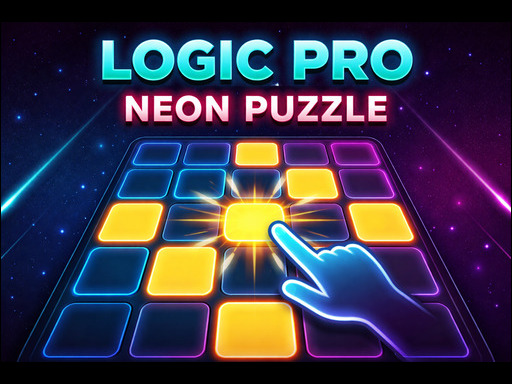
Glowing Logic Puzzle Challenge
Reviews
Glowing Logic Puzzle Challenge takes the classic lights-out toggle mechanic and wraps it in a neon aesthetic that keeps the grid readable. The appeal is in planning: every tap flips a tile and its four neighbors, so efficient solutions require thinking ahead. The gradual difficulty curve suits casual players, and best-score tracking adds a reason to replay. It is not a twitch game, and anyone seeking fast action will find it slow, but puzzle fans get a focused mental workout with no downloads.
About This Game
How the Tile-Toggling Works
Each tap on a lit square flips that square and the four squares directly above, below, left, and right of it. A tap that turns one light off can turn two or three others on, so the board rarely resolves in a straight line. The goal is simple to state: switch every light off. The challenge comes from reading the ripple effect of each move before you commit to it. Because every action touches multiple tiles, the order of your taps matters as much as the taps themselves.
Why the Difficulty Curve Feels Fair
Early boards use sparse, readable patterns that let you learn the toggle rule without punishment. As puzzles progress, the starting layout becomes denser and the chain reactions harder to predict, but the underlying rule never changes. That consistency is what makes the ramp feel earned rather than arbitrary. Players who enjoy logic puzzles tend to appreciate that the game asks for planning, not reflexes or luck.
Neon Presentation and Mobile Play
The modern neon visual style keeps the grid legible while giving the game a distinct look. Bright tiles against a dark background make on and off states easy to distinguish at a glance. The interface is built for touch, so tapping on a phone or tablet feels natural, and the game runs in any browser without downloads or installations. Sessions can be as short as a few minutes or as long as you want to keep solving.
Tracking Progress and Improving
A best-score feature records your results, which turns the game into a personal optimization exercise. Once you clear a board, the next goal is clearing it in fewer moves. That feedback loop rewards pattern recognition: the more you play, the faster you spot which tiles are worth tapping and which should be left alone. It is a straightforward way to build problem-solving habits without any time pressure.
Editorial Notes
Compatibility
System Requirements



Comments
0 comments